
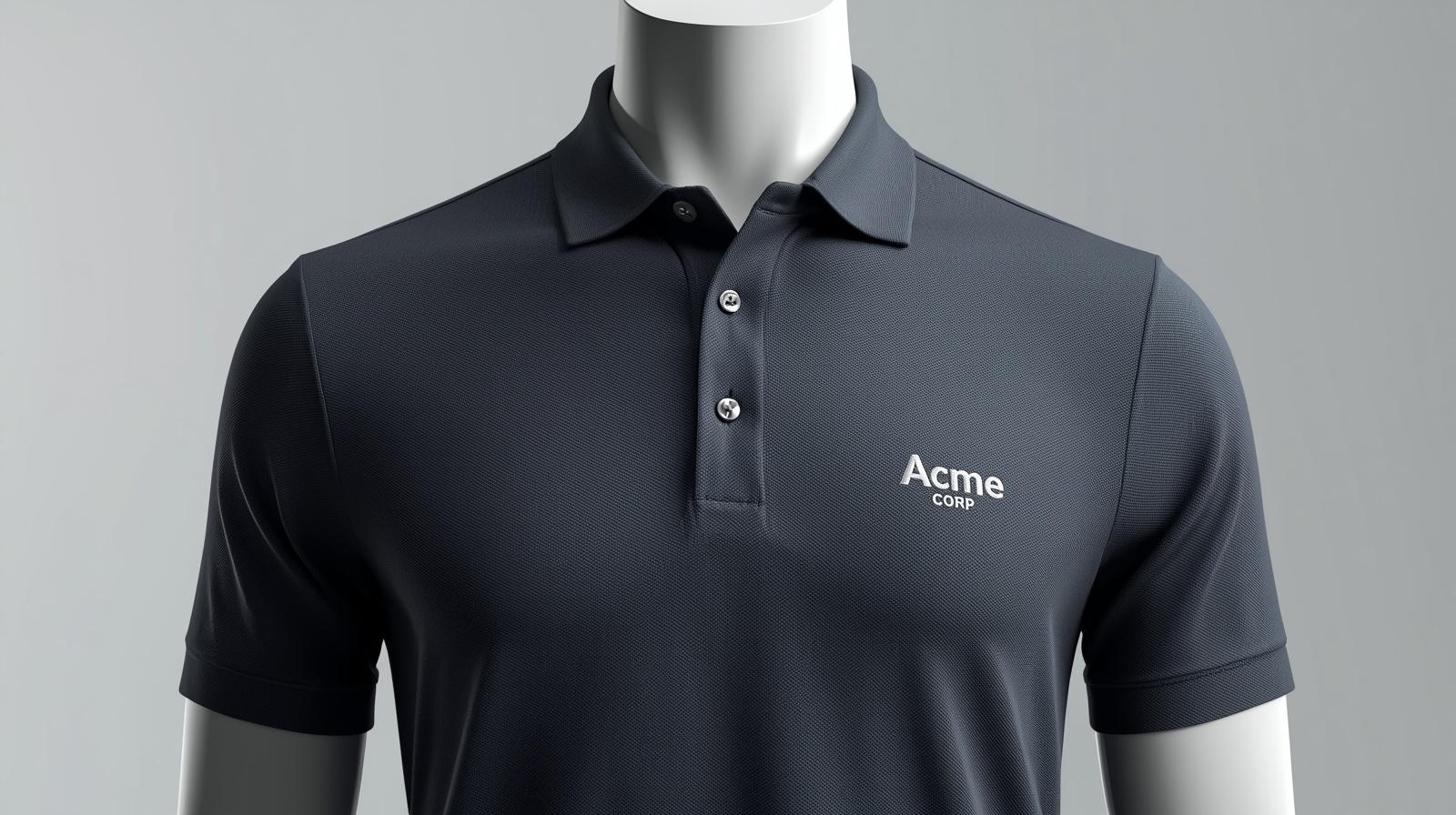
At some point in the evolution of the workplace, someone decided that the polo shirt was the ideal canvas for a company logo. That decision has never really been questioned since.
The “company polo” became a mainstay of corporate life; as immutable as mandatory fun and the phrase “circling back.” If your organization has ever launched an employee recognition program, onboarded a new team member, had employees attend a conference together, or celebrated a milestone of any kind, there’s a near-certainty that polo shirts were involved. Piled into boxes and handed out by enthusiastic Marketing and HR staffers with genuine enthusiasm, they were accepted by employees with the kind of polite smile that doesn’t quite reach the eyes.
The polo shirt is, in theory, business casual. In practice, it is neither business nor casual, but rather a garment suspended in an uncomfortable liminal zone where formality and leisure cancel each other out and produce something that flatters essentially no one. Not the tall person whose torso it skims in all the wrong places, not the shorter person swimming in a size that was probably the only one left, and, let’s be honest, not even the tennis player or golfer, for whom the polo was ostensibly designed.
And yet, here we are. Every fiscal year, organizations spend real money – budget that could theoretically fund professional development, or better coffee, or at minimum a modestly improved onboarding experience – on polo shirts. Stiff, heavy polo shirts in colors selected by committee, embroidered with a logo that will be permanently affixed to the left breast, which is, without exception, the exact wrong location for approximately every human body it encounters.
The Fabric Problem
Let’s start with construction, because the fabric deserves its own reckoning. The traditional corporate polo tends toward a heavy pique cotton that’s designed to hold its shape and project a certain… seriousness of purpose, I suppose. It is also, in practice, quite warm; particularly delightful in the summer months when your organization decides to send everyone to an outdoor event in matching polos, and they all spend the afternoon wilting in unison. And if the organization has moved toward the more “modern” moisture-wicking performance fabric – the kind that’s marketed as breathable and athletic – the experience is not meaningfully better, because that fabric will cling in ways that feel deeply personal. (And is rarely flattering to anyone who is not actively competing in a triathlon).
The Neckline Problem
Then there’s the neckline, which is to say: the placket. That two-to-three-inch strip of buttons sitting at the collar, rubbing against your neck with the persistence of a minor grievance. For anyone who has worn a polo for more than two hours, that placket becomes impossible to ignore; a low-grade irritant that you keep trying to adjust, unconsciously, approximately every eighteen minutes throughout the event. It’s the kind of design detail that makes you understand, at a visceral level, why turtlenecks need to have a revival.
Women, in particular, have reached a kind of collective, unspoken consensus on the polo neckline, and that consensus is not favorable. The collar sits at an awkward height, neither open enough to be comfortable nor structured enough to look deliberate, and the buttons suggest a formality that the rest of the shirt doesn’t quite support. It’s a highly unflattering neckline that commits to nothing while simultaneously managing to irritate everyone.
The Logo Problem
And then we arrive at the logo; the whole reason we’re here and the very point of the shirt’s existence. The logo is embroidered with careful precision onto the left breast and placed, through some alchemy of garment sizing and human biology, in a location that is uniquely – and reliably! – wrong for women across the full spectrum of body types, ages, and sizes. It’s too high on one person, too low on another, and occasionally landing in a spot so anatomically nipple-specific that it becomes a conversation starter in itself.
The logo, to be clear, is not the problem; it merely has the reasonable ambition to represent the company brand. It’s the placement of the logo that raises the question of whether anyone involved in this process has ever worn one of these shirts, or whether the decision-making happened entirely as an abstract exercise.
Safe, Not Strategic
Now the impulse behind giving people corporate branded apparel – shirts, bags, mugs, whatever – is a fundamentally nice human gesture. There’s warmth in it and organizations that invest in belonging and shared identity are doing something meaningful. The intent behind the polo is not the problem.
The problem is that the polo has become the default because it feels “safe”. Oh, it’s undoubtedly the “best practice” of corporate swag; no one gets fired for ordering polo shirts, no one raises an eyebrow, and no one challenges the assumption that this is simply what you do. So, the purchase requisition gets approved, the shirts are ordered in bulk, they arrive 14-17 business days later, and they’re distributed by already-overworked department supervisors. Each employee takes the shirt home and shoves it in the bottom drawer of a dresser where it is destined to reside for eternity with an occasional appearance for either yard work or the casual Friday when every other wardrobe option is in the laundry.
But if organizations are willing to think critically about engagement strategy and employee experience and about whether their systems and processes meet the needs of the people using them (and most organizations will tell you they are), then perhaps it’s not too radical to extend that thinking to the corporate polo shirt. To ask before placing the default order:
- Does this represent ALL of us?
- Does anyone even want to wear this style/color/fabric?
- Does this shirt make the people wearing it feel good?
- Does it fit and/or flatter the range of bodies on our team … or just the theoretical average (male) body someone was imagining?
The Corporate Polo Shirt endures because no one has asked, for 50+ years, whether it should continue to do so. And that, if you’ll forgive my pointing it out, is a very HR thing to do.